
Wine and Food Pairing: The Complete Guide (From a French Winemaker)
In France, wine never arrives alone. It arrives with bread, with cheese, with laughter around the table. My earliest memory of wine is not a tasting note or a score -- it is my grandfather pouring a glass of red while my grandmother set a terrine on the table in Champagne. That is what food and wine pairing truly means: not a formula, but a conversation between what is in your glass and what is on your plate.
I am Sebastien LeSeurre, a sixth-generation winemaker now making wine on the shores of Keuka Lake in the Finger Lakes. After 23 harvests across France, New Zealand, Australia, and the United States, I have learned that the best pairing is often the simplest one -- and that anyone can learn to do it well.
This food and wine pairing guide shares the principles my family has followed for generations, along with practical charts and tips you can use tonight at your own dinner table.
The French Approach to Pairing: Why We Say "A Table"
In my family, we never say "let's have wine." We say "a table" -- come to the table. The wine is already there, chosen not by a chart on the wall but by what is cooking in the kitchen. A roast chicken with herbs from the garden calls for a round, golden Chardonnay. A light summer salad with goat cheese wants a crisp, dry Rose.
This is the French philosophy: wine is food. They belong together. And the goal is not perfection. The goal is accord -- the French word for pairing, which also means harmony. You are looking for a moment when the food and the wine make each other better.
That is the only rule you truly need. Everything else is just helpful guidance.
5 Simple Principles of Food and Wine Pairing
Whether you are a wine pairing beginner or someone who has been drinking wine for decades, these five principles will guide you to a satisfying accord every time.
1. Match the Weight
Light food calls for light wine. Rich food calls for a fuller-bodied wine. A delicate fillet of sole would be overwhelmed by a heavy Cabernet, just as a slow-braised short rib would make a light Riesling disappear.
Think of it like volume in a conversation: both the food and the wine should be able to speak without shouting over each other.
Quick guide:
- Light dishes (salads, seafood, fresh vegetables) -- pair with Riesling, Sauvignon Blanc, dry Rose
- Medium dishes (chicken, pork, pasta) -- pair with Chardonnay, Pinot Noir, lighter reds
- Rich dishes (steak, lamb, braised meats) -- pair with Cabernet Franc, Merlot, bold red blends
2. Complement or Contrast
You can go in two directions: echo the flavors, or play against them.
Complement: A buttery, oak-aged Chardonnay with a cream sauce -- both rich, both round, and together they amplify each other.
Contrast: A bright, high-acid Riesling with a rich, fatty duck confit -- the acidity cuts through the fat and refreshes your palate. This is one of the great secrets of French cuisine.
Both approaches work. The only combination that does not work is pairing two things that simply ignore each other.
3. What Grows Together Goes Together
This is one of the oldest principles in French winemaking, and it holds true everywhere. Wines and foods from the same region have evolved together over centuries.
Alsatian Riesling with choucroute. Burgundy Pinot Noir with coq au vin. And right here in the Finger Lakes, our mineral-driven Rieslings pair naturally with the fresh trout from our lakes and the sharp cheddar from local farms.
If you are visiting the Finger Lakes, you are already following this principle without trying.
4. Follow the Sauce, Not the Protein
This is the tip that surprises most people. A grilled chicken breast with lemon and herbs is a completely different pairing than the same chicken smothered in a mushroom cream sauce.
The first wants a crisp white or dry Rose. The second wants a richer Chardonnay or even a light Pinot Noir. The sauce determines the weight, the flavor, and therefore the wine.
5. Trust Your Palate
In my family, we always say: "Le meilleur vin, c'est celui que tu aimes." The best wine is the one you love.
There are no wrong pairings. If you love a glass of Riesling with your steak, drink it with pride. These principles are a starting point, not a rulebook. The goal is pleasure.
Wine and Cheese Pairing Chart
If there is one pairing question I hear more than any other, it is: how do I pair wine and cheese? Here is a chart I use when I set up our cheese boards at the winery.
| Wine Style | Best Cheese Pairings | Why It Works | |---|---|---| | Chardonnay (unoaked or lightly oaked) | Brie, Camembert, Gruyere | The creamy texture of the cheese mirrors the roundness of the wine | | Chardonnay (oak-aged, buttery) | Triple-cream Brie, aged Comte | Rich meets rich -- the weight is balanced | | Dry Riesling | Aged Gouda, sharp cheddar, Munster | The wine's bright acidity cuts through the richness of the cheese | | Off-dry Riesling | Blue cheese, Roquefort, goat cheese | A touch of sweetness tames the salt and tang | | Rose (dry) | Fresh mozzarella, feta, mild cheddar | Light, refreshing wine with light, fresh cheese | | Cabernet Franc / Red Blends | Aged cheddar, Comte, Manchego | The tannins in the wine soften against the fat in aged cheese | | Sparkling | Parmesan, aged Gouda, any hard cheese | The bubbles and acidity cleanse the palate between bites |
The golden rule of wine and cheese pairing: The stronger the cheese, the more structure (acidity or sweetness) you need in the wine. A gentle Brie is easy to pair with almost anything. A pungent Roquefort needs either a bold red or an off-dry white to stand up to it.
We serve artisanal cheese and charcuterie boards at the winery every day -- come sit on the terrace, order a glass, and practice your pairings with a view of Keuka Lake.

Wine Pairings by Dish: A Practical Reference
What Wine Goes with Salmon?
Salmon is one of the most versatile fish for wine pairing because of its rich, fatty texture. My recommendations:
- Chardonnay -- a lightly oaked Chardonnay with its round, buttery notes is the classic match for grilled or roasted salmon
- Dry Rose -- especially in summer, a crisp Rose with bright acidity complements salmon beautifully, whether grilled, smoked, or served as tartare
- Pinot Noir -- if you prefer red, a lighter Pinot Noir works with salmon's richness without overpowering it
Avoid: Very tannic reds (Cabernet Sauvignon, heavy Merlot) -- the tannins can turn metallic against the fish oils.
What Wine Goes with Chicken?
It depends entirely on the preparation:
- Roast chicken with herbs -- Chardonnay or dry Rose
- Chicken in cream sauce -- oaked Chardonnay
- Fried or spicy chicken -- off-dry Riesling (the sweetness calms the spice)
- Chicken with tomato-based sauce -- a lighter red like Pinot Noir or Cabernet Franc
What Wine Goes with Steak?
Red wine is the natural partner. The tannins in red wine bind with the proteins in meat, softening both the wine and the steak:
- Grilled ribeye or NY strip -- Cabernet Franc or a bold red blend
- Filet mignon -- Pinot Noir or a medium-bodied red
- Pepper steak -- a spicy, peppery red blend
What Wine Goes with Pasta?
Follow the sauce:
- Tomato-based (marinara, bolognese) -- Cabernet Franc, Sangiovese, or a medium red
- Cream-based (Alfredo, carbonara) -- oaked Chardonnay
- Pesto or olive oil -- Sauvignon Blanc or dry Riesling
- Seafood pasta -- dry Riesling or unoaked Chardonnay
What Wine Goes with Seafood?
- Shellfish (shrimp, lobster, crab) -- Chardonnay or sparkling
- White fish (sole, halibut, cod) -- dry Riesling or Sauvignon Blanc
- Sushi and raw fish -- dry Riesling (the acidity and minerality are a natural match)
- Grilled fish -- dry Rose or Chardonnay
What Wine Goes with Charcuterie?
A charcuterie board is one of the easiest things to pair because the variety of flavors means almost any wine works:
- Dry Rose -- the all-purpose charcuterie wine, with enough acidity to handle cured meats
- Dry Riesling -- pairs with everything from prosciutto to cornichons
- Light reds -- Pinot Noir, Cabernet Franc, Gamay
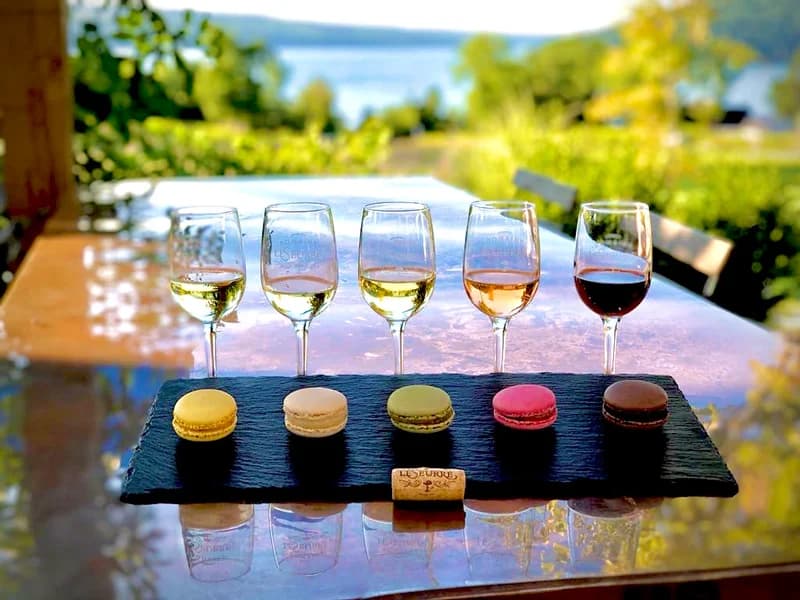
This is exactly what we do at Domaine LeSeurre: our Signature Wine and Food Pairing experience pairs five wines with five carefully chosen bites from artisanal producers, demonstrating how the right accord transforms both the food and the wine.
The Secret of Wine and Macaron Pairing
Here is something no other winery in the Finger Lakes offers, and it has become one of our most beloved experiences: pairing wine with French macarons.
When people first hear "wine and macarons," they look skeptical. When they taste the first pairing, their eyes go wide. Here is why it works:
The sweetness bridge. A macaron is sweet, but not overpoweringly so. When you pair it with a wine that has just enough residual sweetness or fruit-forward character, the sweetness levels harmonize rather than compete. The wine does not taste sugary -- it tastes more complete.
The texture contrast. A macaron has a crisp shell and a soft, creamy interior. When you sip wine between bites, you get a play of textures -- the liquid against the crunch, the creaminess against the acidity -- that keeps your palate engaged.
The flavor bridge. A raspberry macaron with a Rose that has red fruit notes. A pistachio macaron with a mineral-driven Riesling. A salted caramel macaron with an oak-aged Chardonnay. Each pairing creates a conversation between the flavors that neither the wine nor the macaron could have alone.
Our Taste of France experience ($28 per person) pairs five French-style macarons with five of our wines in a guided, seated tasting. It is the most French thing you can do in the Finger Lakes -- and it is something Celine and I created because this is exactly how we entertain friends at home.
What Food Goes with Riesling: A Deep Dive
The Finger Lakes is Riesling country, and Riesling is one of the most food-friendly wines in the world. But not all Rieslings are the same, and knowing the difference between dry and off-dry changes everything about pairing.
Dry Riesling Pairings
Our dry Rieslings have bright acidity, citrus notes, and a mineral backbone that comes from the slate soils around Keuka Lake. They are crisp, clean, and refreshing.
Best pairings for dry Riesling:
- Sushi and sashimi -- the minerality echoes the ocean
- Fresh oysters and shellfish
- Thai or Vietnamese cuisine -- the acidity handles the herbs, the dryness lets the spice sing
- Goat cheese salad
- Light fish dishes with lemon or herbs
- Charcuterie and cured meats
Off-Dry Riesling Pairings
Our off-dry Rieslings have a hint of residual sweetness balanced by vibrant acidity. They are not "sweet wines" -- they are wines with a touch of softness that makes them incredibly versatile.
Best pairings for off-dry Riesling:
- Spicy food -- Indian, Thai, Szechuan -- the sweetness calms the heat
- Blue cheese and strong cheeses
- Pork dishes, especially with fruit-based sauces (apple, peach, cranberry)
- Smoked salmon or smoked trout
- Duck and game birds
- Fruit-based desserts (tarts, crumbles, poached pears)
The Riesling rule: The spicier the food, the more residual sweetness you want in the wine. A bone-dry Riesling with a fiery curry will fight. An off-dry Riesling with the same curry will dance.
Want to taste the difference yourself? Explore our Riesling collection in the shop or visit us for a guided tasting where we walk you through dry, off-dry, and dessert Rieslings side by side.
Hosting a Wine and Food Pairing at Home: Practical Tips
You do not need a sommelier's certification to host a pairing at home. Here is how we do it at our family table.
Start Simple
Pick three wines and three foods. That is it. A white, a rose, a red. A cheese, a cured meat, a chocolate. Taste each wine with each food and notice what happens. You will immediately discover pairings you love and pairings that do not work -- and both are valuable.
Serve Wine Slightly Cool
Whites and roses should be chilled (45-50 degrees F). Reds should be slightly below room temperature (60-65 degrees F). A wine that is too warm tastes flat. A wine that is too cold hides its flavors. The right temperature makes your pairing work better.
Go from Light to Rich
Start with your lightest wine and lightest food, then build toward the richest. Your palate will thank you. A bold red after a delicate Riesling works. A delicate Riesling after a bold red disappears.
Give Each Pairing a Moment
Taste the food. Then sip the wine. Then taste them together. The magic is in that third step -- the moment when the wine and the food meet on your palate and become something new. Encourage your guests to notice what changes.
Do Not Overthink It
The best pairing dinners I have attended -- and hosted -- are the ones where people relax, try things, laugh at the combinations that do not work, and celebrate the ones that do. Wine is meant to bring people together. Santé.

Experience Wine and Food Pairing at Domaine LeSeurre
Reading about pairing is useful. Tasting it is unforgettable.
At Domaine LeSeurre, we offer three ways to experience food and wine pairing in person:
- A Taste of France ($28) -- Five French-style macarons paired with five wines. Seated, guided, and unlike anything else in the Finger Lakes. Book your Taste of France experience
- Signature Wine and Food Pairing ($35) -- Five artisanal bites from local and European producers paired with five award-winning wines. A seated experience that takes you through the full range of accord. Reserve your spot
- Wine by the Glass and Artisanal Plates -- Cheese boards, charcuterie, French desserts, and wine by the glass on our terrace overlooking Keuka Lake. No reservation needed -- just come, sit, and stay as long as you like.
We are open daily from 10am to 6pm at 13920 State Route 54, Hammondsport, NY. For groups of 8 or more, call us at (607) 292-3920.
And if you want to bring the experience home, join our Wine Club for 15% off all wines, free tastings, and access to our exclusive sparkling wines.
We look forward to sharing a glass with you. A table.
Frequently Asked Questions
What is the basic rule of wine and food pairing?
Match the weight of the wine to the weight of the food. Light dishes pair with light-bodied wines, and rich dishes pair with full-bodied wines. Beyond that, look for flavors that either complement or contrast each other. And remember: the best pairing is the one you enjoy most.
What wine goes best with cheese?
It depends on the cheese. Soft, creamy cheeses like Brie pair beautifully with Chardonnay. Sharp or aged cheeses like cheddar and Comte love Cabernet Franc or a dry Riesling. Blue cheeses are best with off-dry Riesling or even a dessert wine. See our full wine and cheese pairing chart above.
What wine pairs with salmon?
Chardonnay is the classic choice -- its round, buttery character mirrors the richness of the salmon. Dry Rose is also a wonderful option, especially in warmer months. If you prefer red, try a lighter Pinot Noir.
What food goes with Riesling?
Riesling is one of the most versatile food wines in the world. Dry Riesling pairs with seafood, sushi, goat cheese, and Asian cuisine. Off-dry Riesling is the go-to for spicy food, smoked fish, blue cheese, and pork with fruit sauces.
Can you pair wine with dessert?
Yes, and it is one of the great pleasures of wine. The key principle is that the wine should be at least as sweet as the dessert, or the wine will taste thin and sour. A late-harvest Riesling with a fruit tart. A sparkling Rose with fresh berries. Or -- our personal favorite -- French macarons with a carefully chosen wine. Come try it yourself.
Sebastien LeSeurre is the co-founder and winemaker of Domaine LeSeurre Winery on Keuka Lake in the Finger Lakes. A 6th-generation Champagne family winemaker with an OIV Master's degree and 23 harvests across four continents, he crafts 30+ artisanal wines marrying French heritage with Finger Lakes terroir. [Learn more about our story](/our-story/).